Showing posts with label American alligator. Show all posts

Wednesday, June 2, 2021

Friday, November 1, 2019

Software to the rescue

I'm hesitant to manipulate my photos in software. I want to use my slowly-improving photographic skills to produce the best picture possible. I also don't have much interest in learning to use the software and I don't want to spend time running each picture I decide to keep through the software. However, software can fix some photographic mistakes.

I'm learning about my camera's "program mode" and have sometimes used it instead of automatic mode. Besides learning about program mode, I need to learn to check the camera's settings because the settings stick after turning the camera off or switching to automatic mode and back.

I finished my latest trip to the Columbus Zoo in the reptile house, and I had apparently set the white balance to fluorescent light because many of the animals live under such light. (Being able to set the white balance is one reason I use program instead of automatic mode.) My first shots of young, gray flamingos at the Toledo Zoo days later used the same leftover setting, and they came out with a blue tint. With software from Nikon I was able to easily change the white balance to daylight.
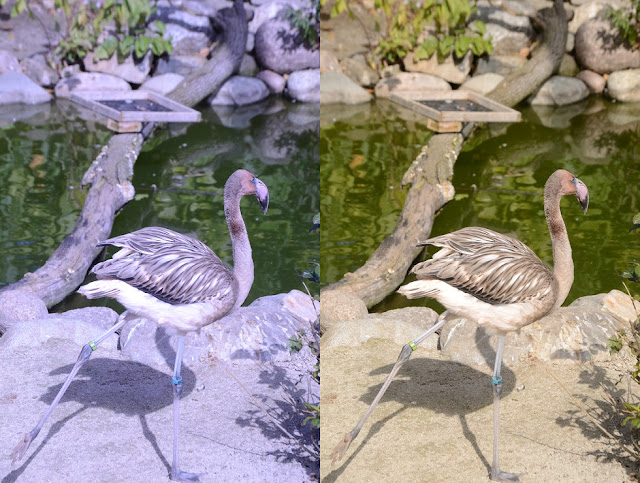

Left half: Incorrect white balance. Right half: White balance corrected using software
Left: Photo from camera with fluorescent white balance. Right: White balance corrected to daylight in software


Another setting I've forgotten is exposure compensation (another reason to use program mode). I don't remember why I had chosen exposure value +1, but that's what was leftover from a previous zoo visit. The value is right there in the display on top of the camera, but did I look? Nope.

The alligator below is nearly black, but the photo from the camera doesn't show that, and the tip of her tongue is washed-out. I was able to reset the exposure compensation to zero in the Nikon software and get a more accurate image.
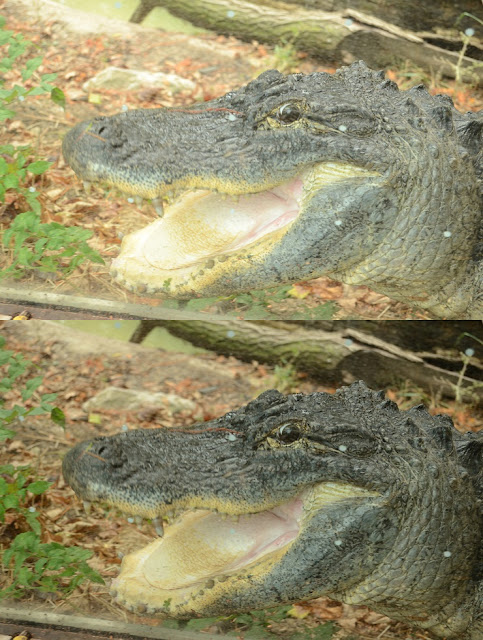
 
Top half: Exposure compensation +1 stop. Bottom half: Exposure compensation corrected to 0 using software
Top: Image from camera with EV +1. Bottom: Exposure compensation corrected to EV 0 in software
My ignorance of EV +1 continued when I left the alligators and visited the Tasmanian devils. I corrected the exposure compensation in software, but, in this case, I prefer the original image to the corrected image. In the bottom photo, the devil's body is mostly a featureless black blob while the body in the top photo shows some subtle shading.
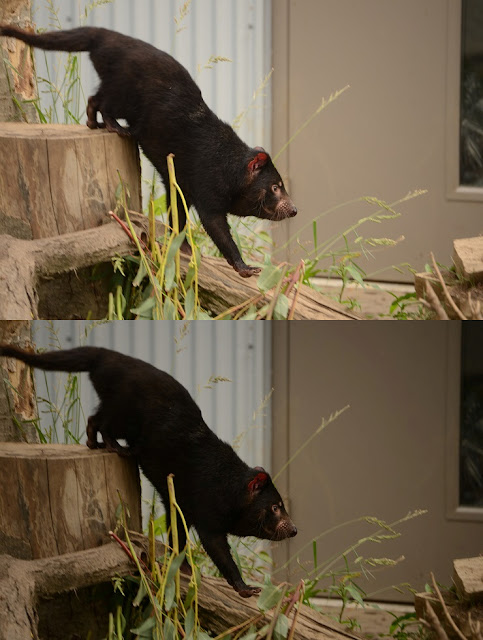
Top half: +1 stop exposure compensation. Bottom half: No exposure compensation, thanks to software
Top: Image from camera with EV +1. Bottom: Exposure compensation set to +0 in software


Besides remembering to check the white balance and exposure compensation settings before shooting, I need to remember to check the camera's mode the first place.

Thursday, October 17, 2019

Alligator action

I went to the Columbus Zoo last week and noticed a small group of small people (more kids than adults) at the alligator exhibit. In my experience, the alligator is motionless in the water or motionless in the grass, but I stopped to take a look. The photos aren't great, but the events were interesting.

May was on land, right up against the viewing area.

An alligator with her mouth open, showing a pink-and-yellow tongue
May, an American alligator. The white spots are on the glass that separates primates from reptiles.
Girl was lurking in the water. 

Girl's head--eyes and nostrils--are above water.
Girl. Yep, that's her name.
A zookeeper and a docent were present, and they explained what was going on. May was alone in the enclosure over the summer and Girl had been recently added. May and Girl have been together before, but the reintroduction was a little rocky (something like Clyde and his flock).

Girl left the water and May moved away.

Girl is on the pond's bank.
Girl follows May.
Girl caught up to May and gave a nip on May's tail before May made it into the water.


At the edge of the pond, Girl has her mouth open on May's tail.
Girl nips at May's tail (dang red reflection).


May quickly returned to land. It was a bit of a struggle getting a grip on the concrete bank.

May's back foot scratches at the pond's bank as she climbs out.
May climbs out of the pool.

There are red scratches on May's tail.
The keeper was not concerned about the superficial wound.

May appears to give a toothy smile.
May returned to where the primates could see her up-close.

The alligator pond is adjacent to the reptile house, but I couldn't see a door. I'd been wondering how the alligators get inside, so I asked the docent. She said the gators are trained to go into crates for transport. (I should've also asked how the crates are taken inside.)

Pretty much every keeper whose talk I've heard emphasizes that animals are trained so the keepers can care for them. Elephants present a foot for inspection and cleaning through an opening in a barrier. Giraffes approach a fence and allow their blood to be drawn.